
When a client, employee, or family member turns 65, Medicare questions often arrive alongside decisions about retirement, employer coverage, and taxes. The details can look like insurance questions. Many of the most important ones are really questions about timing.
Professionals do not need to become Medicare experts to be helpful. But recognizing a few common assumptions can help you know when to raise the topic, and when to encourage someone to verify their dates with an authoritative source.
1. Assuming COBRA keeps the Part B clock on hold
This is one of the easiest timing rules to miss. A person may leave a job, elect COBRA, and assume the continuation coverage gives them more time to enroll in Medicare Part B.
Generally, it does not. The Part B Special Enrollment Period (SEP) is based on coverage through current employment, either the person’s own or a spouse’s. COBRA and retiree coverage generally do not count as current-employment coverage for this SEP.
For someone eligible for the SEP, the eight-month enrollment period generally starts after the employment or qualifying group health coverage ends, whichever happens first. The clock can keep running even if the person elects COBRA. Waiting until COBRA ends may mean the SEP has already passed.
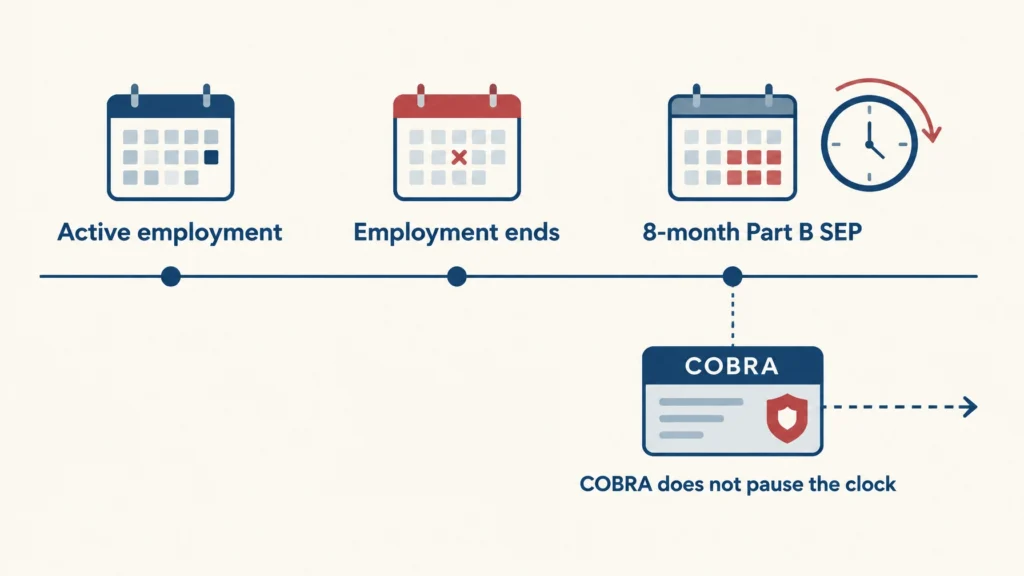
A late Part B enrollment can have lasting consequences. The penalty is generally 10% of the standard Part B premium for each full 12-month period a person could have had Part B but did not. It generally continues for as long as the person has Part B. The same caution applies to prescription drug coverage. A Part D late enrollment penalty may apply after 63 or more consecutive days without Part D or other creditable drug coverage following the initial enrollment opportunity. It is based on the number of uncovered months and generally continues for as long as the person has Medicare drug coverage. People who qualify for Extra Help generally do not pay this penalty.
For HR professionals, benefits coordinators, and advisors, the useful question is not simply “Does the person have coverage?” It is “Is the coverage based on current employment, and when does that employment or coverage end?” Medicare explains the Part B enrollment periods and the rules for COBRA coverage.
2. Assuming everyone is automatically enrolled at 65
Turning 65 does not, by itself, mean a person will be enrolled automatically. Automatic enrollment in Medicare Parts A and B generally applies when someone is already receiving Social Security or Railroad Retirement benefits at least four months before the month they turn 65.
If that does not describe the person, they generally need to take action to enroll. The Initial Enrollment Period is a seven-month window: the three months before the birthday month, the birthday month, and the three months after it. The right enrollment timing can depend on employment and other coverage, so the window should be considered alongside those details.
Part D prescription coverage requires a separate check. It is not automatically included just because someone turns 65 or has Parts A and B. In most cases, a person must actively select drug coverage or confirm that existing drug coverage is creditable. There are special circumstances in which some people may be automatically enrolled in a drug plan, so it is better to verify rather than assume either way.
The Social Security Administration’s Medicare enrollment guidance and Medicare’s information on who is automatically enrolled are useful starting points.
3. Treating Medigap enrollment as an annual open window
The federal Medigap Open Enrollment Period is a one-time six-month period. It starts the first month a person is both age 65 or older and enrolled in Medicare Part B. During this period, federal rules provide important protections when buying a Medigap policy.
The window does not reopen every year. After it ends, a person may still be able to apply for a policy, but medical underwriting may apply, except where other guaranteed-issue rights or state rules provide protections. This makes it important to identify when Part B begins, not just when someone turns 65.
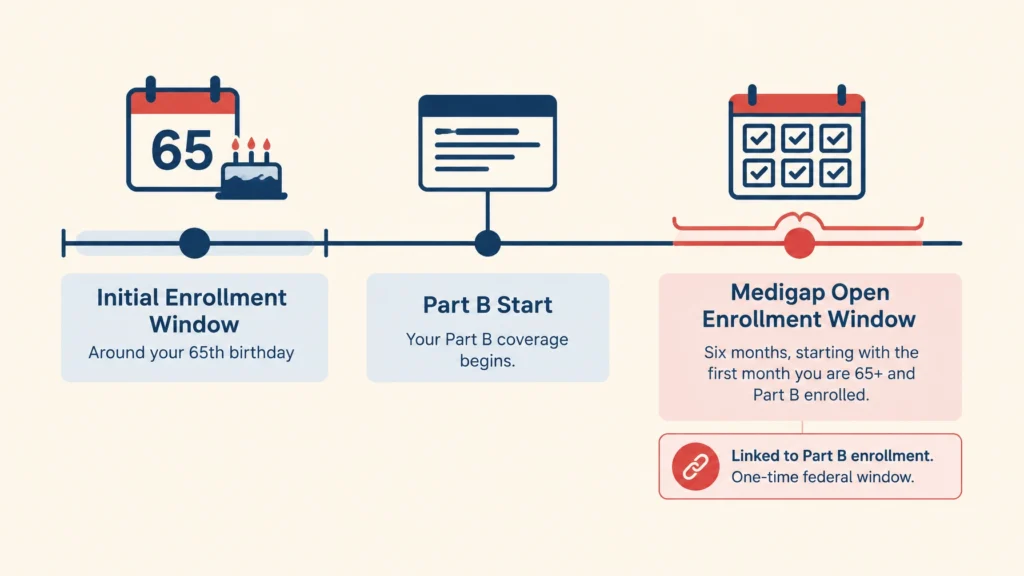
Oklahoma residents have an additional state protection for people who already have a Medicare Supplement policy. Under Oklahoma’s Birthday Rule, currently enrolled Medicare Supplement policyholders can have a 60-day period beginning on their birthday to switch to a policy with equal or lesser benefits. Switching to greater benefits is possible, but the issuer may require medical underwriting. The rule includes a condition that there be no gap in Medicare Supplement coverage greater than 90 days. It is a separate state opportunity; it does not make the federal six-month window annual.
The Medicare guide to buying a Medigap policy and the Oklahoma Insurance Department’s Medigap information explain these protections in more detail.
4. Separating Medicare timing from HSA planning
An employee may plan to work past 65, keep an employer health plan, and continue contributing to a Health Savings Account (HSA). That plan needs a Medicare timing check before enrollment.
Once a person is enrolled in Medicare, their HSA contribution limit is generally zero for the months they are enrolled. There is an additional wrinkle for people who apply for Medicare after 65: Part A may be retroactive, in some cases by up to six months. As a result, HSA contributions made during months covered by retroactive Medicare enrollment can create tax issues.
This is a good moment for coordination, not guesswork. The person’s Medicare effective date, HSA contributions, employer coverage, and planned retirement date may all matter. The IRS discusses Medicare enrollment and HSA contributions in Publication 969, and the Social Security Administration’s Medicare page notes the possible retroactive Part A start date.

A practical way to raise the topic
You do not need to walk someone through every Medicare choice. A short set of timing questions can help surface when they should seek more information:
- When will the person turn 65, and are they already receiving Social Security or Railroad Retirement benefits?
- Will they or their spouse still be working, and is their health coverage based on current employment?
- If employment or coverage is ending, what are the exact end dates, and is COBRA or retiree coverage involved?
- Are HSA contributions continuing, or might Part A take effect retroactively?
- When will Part B begin, and what enrollment windows or coverage decisions follow from that date?
The dates are often the starting point for conversations about retirement, benefits transitions, and tax planning. If the answers are unclear, encourage the person to confirm their situation with Medicare, Social Security, their employer benefits administrator, or a qualified tax professional.
Education first
Professionals do not need to become Medicare specialists. They can make a meaningful difference by recognizing that turning 65 may affect several timelines at once, and by raising the topic early enough for the individual to check their options.
For general background, Sansone Advisory Group offers a Medicare 101 presentation, a plain-language Medicare overview, and answers to common Medicare questions. These resources are educational and intended to help people understand what to ask next.
Sansone Advisory Group is an independent insurance agency serving clients across Oklahoma, including Tulsa and the surrounding communities. We do not offer every plan available in your area. Currently we represent between 1 and 7 organizations which offer between 3 and 58 products in your area. Please contact Medicare.gov or 1-800-MEDICARE to get information on all of your options.
Sansone Advisory Group is not connected with or endorsed by the U.S. government or the federal Medicare program.