
Author: sean

  • What Professionals Get Wrong When Clients Turn 65

    Professionals reviewing a calendar and retirement paperwork together during a calm planning conversation

    When a client, employee, or family member turns 65, Medicare questions often arrive alongside decisions about retirement, employer coverage, and taxes. The details can look like insurance questions. Many of the most important ones are really questions about timing.

    Professionals do not need to become Medicare experts to be helpful. But recognizing a few common assumptions can help you know when to raise the topic, and when to encourage someone to verify their dates with an authoritative source.

    1. Assuming COBRA keeps the Part B clock on hold

    This is one of the easiest timing rules to miss. A person may leave a job, elect COBRA, and assume the continuation coverage gives them more time to enroll in Medicare Part B.

    Generally, it does not. The Part B Special Enrollment Period (SEP) is based on coverage through current employment, either the person’s own or a spouse’s. COBRA and retiree coverage generally do not count as current-employment coverage for this SEP.

    For someone eligible for the SEP, the eight-month enrollment period generally starts after the employment or qualifying group health coverage ends, whichever happens first. The clock can keep running even if the person elects COBRA. Waiting until COBRA ends may mean the SEP has already passed.
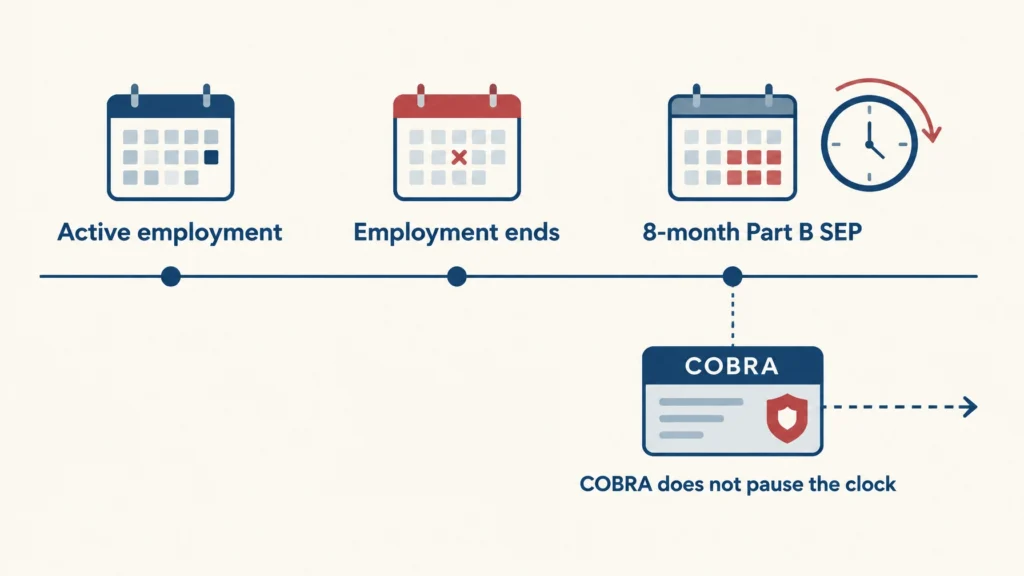
    Illustrated timeline showing that COBRA coverage does not pause the Part B Special Enrollment Period clock

    A late Part B enrollment can have lasting consequences. The penalty is generally 10% of the standard Part B premium for each full 12-month period a person could have had Part B but did not. It generally continues for as long as the person has Part B. The same caution applies to prescription drug coverage. A Part D late enrollment penalty may apply after 63 or more consecutive days without Part D or other creditable drug coverage following the initial enrollment opportunity. It is based on the number of uncovered months and generally continues for as long as the person has Medicare drug coverage. People who qualify for Extra Help generally do not pay this penalty.

    For HR professionals, benefits coordinators, and advisors, the useful question is not simply “Does the person have coverage?” It is “Is the coverage based on current employment, and when does that employment or coverage end?” Medicare explains the Part B enrollment periods and the rules for COBRA coverage.

    2. Assuming everyone is automatically enrolled at 65

    Turning 65 does not, by itself, mean a person will be enrolled automatically. Automatic enrollment in Medicare Parts A and B generally applies when someone is already receiving Social Security or Railroad Retirement benefits at least four months before the month they turn 65.

    If that does not describe the person, they generally need to take action to enroll. The Initial Enrollment Period is a seven-month window: the three months before the birthday month, the birthday month, and the three months after it. The right enrollment timing can depend on employment and other coverage, so the window should be considered alongside those details.

    Part D prescription coverage requires a separate check. It is not automatically included just because someone turns 65 or has Parts A and B. In most cases, a person must actively select drug coverage or confirm that existing drug coverage is creditable. There are special circumstances in which some people may be automatically enrolled in a drug plan, so it is better to verify rather than assume either way.

    The Social Security Administration’s Medicare enrollment guidance and Medicare’s information on who is automatically enrolled are useful starting points.

    3. Treating Medigap enrollment as an annual open window

    The federal Medigap Open Enrollment Period is a one-time six-month period. It starts the first month a person is both age 65 or older and enrolled in Medicare Part B. During this period, federal rules provide important protections when buying a Medigap policy.

    The window does not reopen every year. After it ends, a person may still be able to apply for a policy, but medical underwriting may apply, except where other guaranteed-issue rights or state rules provide protections. This makes it important to identify when Part B begins, not just when someone turns 65.
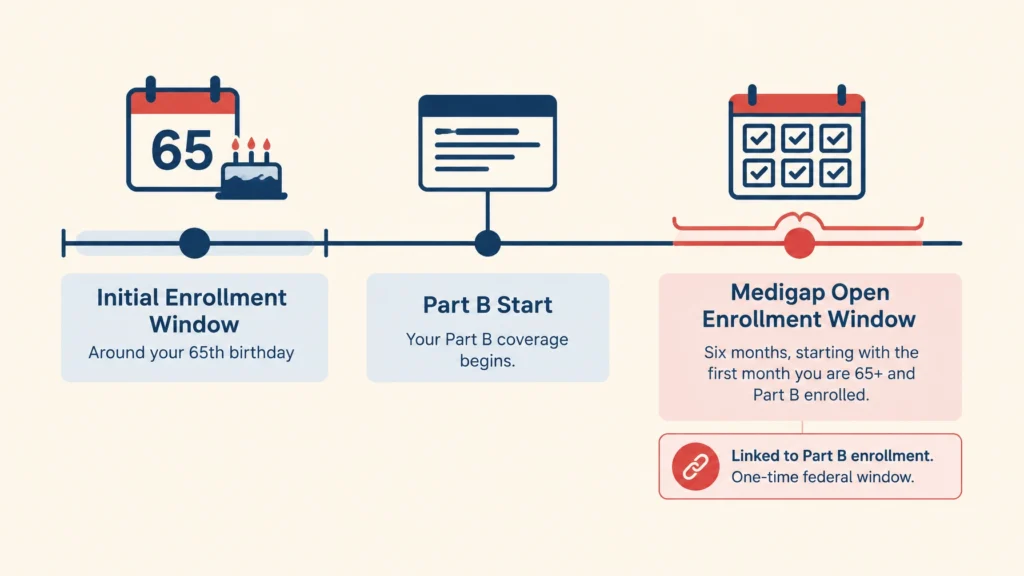
    Calendar illustration showing the one-time Medigap enrollment window beginning with Part B enrollment

    Oklahoma residents have an additional state protection for people who already have a Medicare Supplement policy. Under Oklahoma’s Birthday Rule, currently enrolled Medicare Supplement policyholders can have a 60-day period beginning on their birthday to switch to a policy with equal or lesser benefits. Switching to greater benefits is possible, but the issuer may require medical underwriting. The rule includes a condition that there be no gap in Medicare Supplement coverage greater than 90 days. It is a separate state opportunity; it does not make the federal six-month window annual.

    The Medicare guide to buying a Medigap policy and the Oklahoma Insurance Department’s Medigap information explain these protections in more detail.

    4. Separating Medicare timing from HSA planning

    An employee may plan to work past 65, keep an employer health plan, and continue contributing to a Health Savings Account (HSA). That plan needs a Medicare timing check before enrollment.

    Once a person is enrolled in Medicare, their HSA contribution limit is generally zero for the months they are enrolled. There is an additional wrinkle for people who apply for Medicare after 65: Part A may be retroactive, in some cases by up to six months. As a result, HSA contributions made during months covered by retroactive Medicare enrollment can create tax issues.

    This is a good moment for coordination, not guesswork. The person’s Medicare effective date, HSA contributions, employer coverage, and planned retirement date may all matter. The IRS discusses Medicare enrollment and HSA contributions in Publication 969, and the Social Security Administration’s Medicare page notes the possible retroactive Part A start date.

    Simple planning graphic connecting retirement date, employer coverage end date, and HSA contribution timing

    A practical way to raise the topic

    You do not need to walk someone through every Medicare choice. A short set of timing questions can help surface when they should seek more information:

    1. When will the person turn 65, and are they already receiving Social Security or Railroad Retirement benefits?
    2. Will they or their spouse still be working, and is their health coverage based on current employment?
    3. If employment or coverage is ending, what are the exact end dates, and is COBRA or retiree coverage involved?
    4. Are HSA contributions continuing, or might Part A take effect retroactively?
    5. When will Part B begin, and what enrollment windows or coverage decisions follow from that date?

    The dates are often the starting point for conversations about retirement, benefits transitions, and tax planning. If the answers are unclear, encourage the person to confirm their situation with Medicare, Social Security, their employer benefits administrator, or a qualified tax professional.

    Education first

    Professionals do not need to become Medicare specialists. They can make a meaningful difference by recognizing that turning 65 may affect several timelines at once, and by raising the topic early enough for the individual to check their options.

    For general background, Sansone Advisory Group offers a Medicare 101 presentation, a plain-language Medicare overview, and answers to common Medicare questions. These resources are educational and intended to help people understand what to ask next.

    Sansone Advisory Group is an independent insurance agency serving clients across Oklahoma, including Tulsa and the surrounding communities. We do not offer every plan available in your area. Currently we represent between 1 and 7 organizations which offer between 3 and 58 products in your area. Please contact Medicare.gov or 1-800-MEDICARE to get information on all of your options.

    Sansone Advisory Group is not connected with or endorsed by the U.S. government or the federal Medicare program.


  • Medicare Advantage vs. Medicare Supplement: Which Fits You Best?

    Illustration comparing Medicare Advantage plan networks with Original Medicare paired with a Medicare Supplement policy

    When comparing Medicare Advantage vs. supplement coverage, you’re choosing between two different ways to receive Medicare coverage, not two policies you can use together.

    Medicare Advantage is an alternative way to receive your Medicare Part A and Part B benefits through a Medicare-approved private plan. A Medicare Supplement policy, also called Medigap, works alongside Original Medicare to help pay some out-of-pocket costs.

    Neither option is the right fit for everyone. Understanding how each works, and considering your doctors, prescriptions, budget, and enrollment timing, can help you make a more informed choice.

    The main difference

    A person thoughtfully reviewing doctor, prescription, and pharmacy information

    With Medicare Advantage, you receive Part A and Part B coverage through a private plan. Plans have their own coverage rules and may use provider networks. Most include Part D prescription drug coverage, but details vary by plan.

    With Original Medicare and Medigap, Original Medicare remains your primary coverage. You buy a separate Medicare Supplement policy to help cover certain out-of-pocket costs, such as deductibles, copayments, or coinsurance, depending on the policy. You generally need separate Part D coverage if you want Medicare prescription drug coverage.

    You can’t have Medigap while enrolled in Medicare Advantage. The two options are different coverage paths.

    How Medicare Advantage works

    Medicare Advantage plans, also called Part C, are offered by private companies approved by Medicare. You need both Medicare Part A and Part B to join, and you continue paying your Part B premium.

    Plan rules vary. Depending on the type of plan, you may need to use a provider network, choose a primary care provider, or get approval before certain services. Most Medicare Advantage plans include Part D, but you should confirm drug coverage for any plan you are considering.

    Before enrolling, check:

    • Whether your doctors, specialists, hospitals, and pharmacies are included.
    • Whether your prescriptions are covered and what plan rules apply.
    • What you may pay when you receive care, including deductibles and copayments.
    • The plan’s annual out-of-pocket limit for covered medical services.
    • Whether referrals or prior authorization may be required.

    Plan details can change from year to year. Review current materials carefully rather than assuming a plan’s network, drug coverage, or costs will stay the same.

    How Medicare Supplement coverage works

    A Medicare Supplement policy is private insurance that works with Original Medicare. It can help pay certain out-of-pocket costs left by Original Medicare, according to the policy’s benefits.

    With Original Medicare, you can generally see any provider in the United States that accepts Medicare. There is no Medicare Advantage plan network, though it is still sensible to confirm that a provider accepts Medicare before receiving care.

    Medigap policies do not include prescription drug coverage. If you choose Original Medicare with Medigap and want Medicare drug coverage, you generally enroll in a separate Part D plan.

    When comparing this route, consider the combined cost of your Part B premium, Medigap policy, Part D plan, and any remaining cost-sharing. A Medigap policy can help with certain expenses, but it does not cover every possible health care cost.

    A practical way to compare

    Rather than starting with a plan’s advertised features, begin with your own needs.

    1. Write down your doctors and preferred hospitals. Check whether they accept Medicare and, for Medicare Advantage plans, whether they are in the plan’s network.
    2. Make a medication list. Include each prescription’s name, dosage, and how often you take it. Check coverage and pharmacy options.
    3. Think about how you use care. Consider routine appointments, specialists, and the possibility of needing more care in a given year.
    4. Compare total costs. Look beyond a monthly premium. Consider cost-sharing when you receive care, prescription expenses, and the costs of any separate coverage you need.
    5. Consider flexibility and plan rules. Decide how important provider choice, networks, referrals, and prior authorization are to you.
    6. Review your enrollment timing. Your ability to enroll in a plan and your right to buy Medigap are governed by different rules.

    There isn’t one answer that fits everyone. A useful comparison is the one based on the providers and prescriptions you actually use, and the costs and rules you can manage.

    Enrollment windows matter

    A nonverbal calendar illustration showing that Medicare enrollment periods have distinct timeframes

    Most people first become eligible for Medicare at age 65. The Initial Enrollment Period for Medicare Parts A and B lasts seven months: it begins three months before the month you turn 65 and ends three months after your birthday month. If you’re working past 65 and have employer coverage, your situation may be different. Check with your employer and Social Security before delaying Part B. The Social Security Administration explains Medicare enrollment timing.

    The annual Medicare Open Enrollment Period runs from October 15 through December 7. During this period, people can make certain changes to Medicare Advantage and Part D coverage. It is not a yearly federal Medigap Open Enrollment Period, and it does not automatically guarantee that you can buy a Medigap policy without medical underwriting.

    If you’re already enrolled in Medicare Advantage, the Medicare Advantage Open Enrollment Period runs from January 1 through March 31. During this period, you may generally make one change: switch to another Medicare Advantage plan or return to Original Medicare. This is not a general Medigap enrollment period.

    The one-time Medigap Open Enrollment Period

    Your federal Medigap Open Enrollment Period lasts six months. It starts the first month you are both at least 65 and enrolled in Medicare Part B. During this period, you generally have the right to buy a Medigap policy without being denied or charged more because of a pre-existing health condition.

    This period happens once; it does not repeat each year. After it ends, you may have fewer options unless you qualify for another guaranteed-issue right or state protection. Read more about when you can buy a Medigap policy on Medicare.gov.

    Oklahoma’s Medigap Birthday Rule

    Oklahoma has an additional state protection for eligible Medicare Supplement policyholders. Under the Oklahoma Insurance Department’s guidance, an eligible person with a Medicare Supplement policy may apply during an annual 60-day period beginning on their birthday to switch to a policy with equal or lesser benefits, without medical underwriting or pre-existing-condition exclusions. The birthday is day one of the period. The protection generally requires that there has not been a coverage gap greater than 90 days.

    The Birthday Rule applies to Medicare Supplement coverage, not Medicare Advantage, and does not allow an upgrade to greater benefits without underwriting. It also does not guarantee a lower premium. For current details, review the Oklahoma Insurance Department’s Medicare Supplement FAQs.

    Questions to ask before deciding

    Before you enroll or change coverage, ask yourself:

    • Are my preferred doctors, specialists, and hospitals accessible under this option?
    • How are my prescriptions covered, and which pharmacies can I use?
    • What would I pay in a year with few medical needs, and in a year with more care?
    • Do I understand the rules for changing coverage later?
    • If I’m considering Medigap, am I within my six-month federal Open Enrollment Period or eligible for another protection?

    If you’re turning 65, our Turning 65 Medicare Checklist can help you organize key dates and questions. You can also explore our Medicare FAQs and Medicare in a Nutshell for more plain-English explanations.

    Sean and Cindy Sansone, the local leadership team at Sansone Advisory Group

    Take your time

    Choosing between Medicare Advantage and Medicare Supplement coverage means weighing how you want to receive care, how you use prescription coverage, what providers you want to see, and how costs and plan rules fit your circumstances. If you’d like help understanding the differences, a conversation can be a way to review your questions, without pressure to make a particular choice.

    Sansone Advisory Group is an independent insurance agency serving clients across Oklahoma, including Tulsa and the surrounding communities. We do not offer every plan available in your area. Currently we represent between 1 and 7 organizations which offer between 3 and 58 products in your area. Please contact Medicare.gov or 1-800-MEDICARE to get information on all of your options.

    Sansone Advisory Group is not connected with or endorsed by the U.S. government or the federal Medicare program. This article is for general educational purposes and is not a personalized determination of eligibility, coverage, or enrollment rights. Verify current rules with Medicare.gov, Social Security, or the Oklahoma Insurance Department.

  • Turning 65 Medicare Checklist: 7 Things to Review Before You Enroll

    A couple reviewing their Medicare enrollment timeline together at home

    Turning 65 brings a few important Medicare decisions, but you do not have to make them all at once. A simple checklist can help you understand when to enroll, what coverage you already have, and which details to compare before you choose.

    Use these seven things to review as a starting point. Your next steps may depend on your work status, current insurance, Social Security benefits, and healthcare needs.

    1. Mark your seven-month Initial Enrollment Period

    Your Initial Enrollment Period (IEP) generally lasts seven months: the three months before your 65th birthday month, your birthday month, and the three months after it.

    For example, if your birthday is in October, your IEP generally runs from July through January. If you sign up in the three months before your 65th birthday month, coverage generally starts the first day of your birthday month. If you sign up during your birthday month or the three months after, coverage generally starts the first day of the following month. If your birthday falls on the first day of a month, different timing rules may apply.

    Medicare explains when coverage starts and offers a tool to check when you can sign up.

    What to check: Write down your IEP dates and the date you want coverage to begin. If you are working or have other insurance, confirm how that coverage affects your enrollment timeline before delaying Part A or Part B.

    2. Find out whether you’ll be enrolled automatically

    Some people are automatically enrolled in Medicare Part A and Part B. This generally happens if you already receive Social Security or Railroad Retirement Board benefits at least four months before the month you turn 65. If you are not receiving those benefits, you will usually need to sign up yourself through Social Security.

    Automatic enrollment in Parts A and B does not automatically select a separate Part D prescription drug plan for you. If you need Medicare drug coverage, you will need to review your options and enroll when appropriate.

    What to check: Look for a Medicare card or enrollment notice in the mail. If you are unsure whether you are enrolled, or what coverage is included, confirm directly with Social Security.

    3. Check whether your current coverage lets you delay Medicare

    If you or your spouse are still working and have health insurance through that current employment, you may be able to delay Part B without a late enrollment penalty. The rules depend on the coverage and employer, so confirm the details with the employer’s benefits administrator.

    Some coverage does not give you the same option. COBRA and retiree coverage generally do not count as active-employment coverage for the Part B Special Enrollment Period. If you are no longer in your Initial Enrollment Period, the Part B Special Enrollment Period lasts eight months, beginning the month after the employment or the job-based coverage ends, whichever comes first. That window can begin even if you choose COBRA. In other words, COBRA does not extend that window.

    Retiree coverage may also coordinate with Medicare in a specific way, and may require you to have Medicare Parts A and B. Before making a change, ask how Medicare works with your coverage and whether enrolling in another plan could affect your retiree benefits.

    If you contribute to a Health Savings Account (HSA), ask about the timing before enrolling in Medicare. Enrollment can affect your ability to make HSA contributions.

    What to check: Ask your benefits administrator, in writing if possible:

    • Is this coverage based on current employment?
    • When does the coverage end, and when should I enroll in Part B?
    • Is the prescription coverage considered creditable for Part D?
    • Could enrolling in Medicare or another plan affect my benefits?

    Medicare has additional guidance on working past 65, COBRA, and retiree insurance.

    4. Review Part B and Part D timing

    Late enrollment penalties are worth understanding, but they do not apply to everyone. Special Enrollment Periods and qualifying coverage can affect whether a penalty applies.

    For Part B, the penalty is generally an extra 10% of the standard premium for each full 12-month period you could have had Part B but did not. It usually continues for as long as you have Part B.

    For Part D, a penalty may apply if you go 63 or more consecutive days without Part D or other creditable prescription drug coverage after your initial enrollment opportunity. The penalty is generally calculated using the national base beneficiary premium and the number of uncovered months. That base amount can change each year.

    What to check: If you have drug coverage through an employer, union, or another source, ask the provider whether it is creditable and keep the notice. If you are unsure whether your circumstances qualify for a Special Enrollment Period, check with Social Security or Medicare before deciding to delay.

    For details, see Medicare’s information on late enrollment penalties.

    5. Note your Medigap Open Enrollment Period

    If you choose Original Medicare and are considering a Medicare Supplement policy, also called Medigap, mark this window on your calendar. Your one-time federal Medigap Open Enrollment Period lasts six months. It starts the first day of the month you are 65 or older and enrolled in Part B.

    During this period, insurance companies generally cannot deny you a Medigap policy or charge you more because of a health problem. If you delay Part B because you have qualifying coverage through current employment, your Medigap window generally starts when you enroll in Part B, provided you are 65 or older.

    After the window ends, an insurer may be able to review your health history, charge more, offer fewer choices, or deny an application, unless you have a guaranteed-issue right or other protections. The window does not automatically reopen each year.

    In Oklahoma, there is also a Medicare Supplement “Birthday Rule.” It gives you a 60-day window beginning on your birthday each year to switch to a different Medicare Supplement policy with equal or lesser benefits without medical underwriting, as long as you have not had a gap in coverage greater than 90 days. It cannot be used to move to a policy with greater benefits. Because state rules can change, confirm current details with the Oklahoma Insurance Department.

    What to check: Once you know your Part B start date, note the six-month period and learn what Medigap choices are available. Rules and protections can depend on your circumstances and state law. Medicare explains when you can buy a Medigap policy.

    6. Check your doctors, prescriptions, and pharmacies

    Before choosing coverage, gather the practical details you will need to compare options. Make a list of your doctors and clinics, the prescriptions you take, and the pharmacies you prefer.

    If you are considering Medicare Advantage, check whether your doctors and hospitals participate in the plan’s network and how the plan handles referrals and out-of-network care. If you are considering Original Medicare with Medigap, review how the supplement works alongside Original Medicare and remember that prescription drug coverage is generally reviewed separately through Part D.

    For drug coverage, check each medication’s formulary, pharmacy options, restrictions, and costs. Coverage details can change, so verify current information before enrolling.

    A woman reviewing medication information with a family member

    7. Compare how you want to get your Medicare coverage

    Medicare choices are personal. Some people compare Original Medicare with a Medigap policy and Part D coverage. Others consider Medicare Advantage. Each approach has different rules, costs, networks, and ways of covering care.

    Think about what matters most to you: keeping access to particular providers, how you prefer to manage costs, prescription coverage, and whether you want a network-based plan. Compare the details for your own situation rather than relying on a general description.

    What to check: Review your choices using current information, and ask questions when something is unclear. You can also explore our plain-language answers to common Medicare questions and Medicare basics explained in simple terms.

    Official Medicare resources

    Official Medicare information is available directly through these resources at no cost.

    Local Medicare guidance in the Tulsa area

    If you live in Tulsa, Broken Arrow, Bixby, Jenks, Owasso, or a nearby community, you are welcome to speak with Sean or Cindy at our Tulsa office at 5800 E. Skelly Dr., Suite 560, near I-44 and Yale. We help people check their Medicare enrollment timeline, review whether their doctors are included, and look at prescriptions and pharmacies against plans available in this area.

    Sean and Cindy Sansone, local Medicare advisors in Tulsa

    If a conversation would be helpful, you can schedule a time with Sean or Cindy. There is no obligation to enroll. You can also call us at (918) 289-2607.

    Sansone Advisory Group is an independent insurance agency serving clients across Oklahoma, including Tulsa and the surrounding communities. We do not offer every plan available in your area. Currently we represent between 1 and 7 organizations which offer between 3 and 58 products in your area. Please contact Medicare.gov or 1-800-MEDICARE to get information on all of your options.

    Sansone Advisory Group is not connected with or endorsed by the U.S. government or the federal Medicare program. This article is general education, not a personalized determination of your eligibility or enrollment rights. For official guidance, visit Medicare.gov or call 1-800-MEDICARE.